

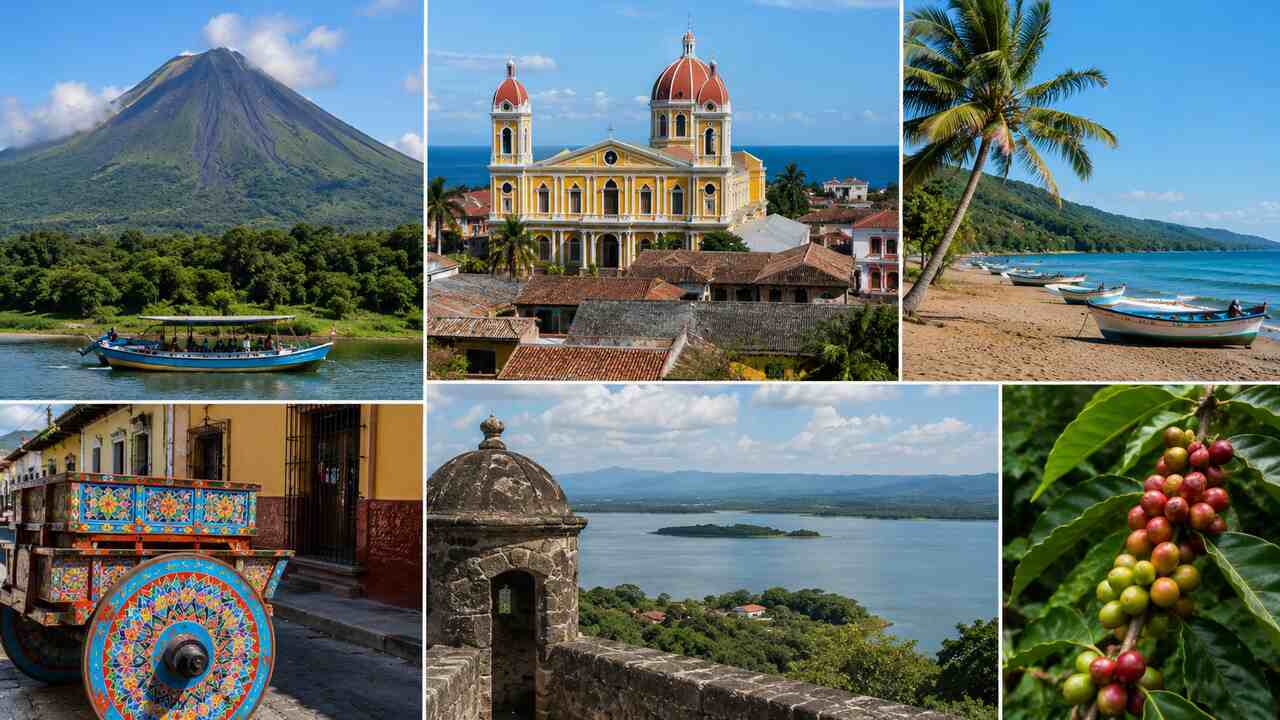
Nicaragua is best known as the “Land of Lakes and Volcanoes,” a nickname that reflects its enormous freshwater lakes and volcanic Pacific landscape. The country is also famous for Ometepe Island, volcano boarding at Cerro Negro, the colonial cities of Granada and León, Pacific surfing, Caribbean islands, Nicaraguan coffee, traditional foods such as gallo pinto and vigorón, poet Rubén Darío, baseball, premium cigars, rum and its revolutionary history.
What makes Nicaragua especially interesting is the range packed into one Central American country. Its international identity is not built around a single attraction. Geography, Spanish and Indigenous heritage, Afro-Caribbean culture, literature, agriculture and twentieth-century history have all shaped what Nicaragua is known for today.
What Is Nicaragua Most Famous For?
For a quick overview, these are the features most strongly associated with Nicaragua:
| Nicaragua is known for | Why it stands out |
|---|---|
| Lakes and volcanoes | The country’s defining geographic identity |
| Lake Nicaragua | Central America’s largest freshwater lake |
| Ometepe Island | Two volcanoes rising from Lake Nicaragua |
| Cerro Negro | Famous for volcano boarding |
| Granada | Colorful colonial architecture and lakeside setting |
| León | Colonial history, cathedral, culture and revolutionary heritage |
| Pacific Coast | Surfing around San Juan del Sur, Popoyo and nearby beaches |
| Corn Islands | Caribbean beaches, reefs and Creole influence |
| Nicaraguan food | Gallo pinto, nacatamal, vigorón and regional Caribbean dishes |
| Coffee, cigars and rum | Important products strongly associated with Nicaragua |
| Rubén Darío | One of the Spanish language’s most influential poets |
| El Güegüense | UNESCO-recognized Nicaraguan theatrical tradition |
| Baseball | Nicaragua’s national sport |
| Sandinista Revolution | A major event in modern Latin American history |
Nicaragua Is the Land of Lakes and Volcanoes
The expression most closely attached to Nicaragua is “the Land of Lakes and Volcanoes.”
It is more than tourism branding. Much of western Nicaragua lies along a volcanic chain that includes names such as Masaya, Mombacho, Momotombo, San Cristóbal, Concepción, Maderas and Cerro Negro. Nicaragua’s tourism institute describes a Volcano Route extending through six departments and encompassing around 20 volcanoes as well as crater lakes and nature reserves.
These volcanoes are not all identical. Mombacho supports cloud forest. Concepción rises dramatically above Ometepe Island. Masaya is associated with one of the country’s best-known volcanic landscapes, while the black slopes of Cerro Negro have become an adventure-sports destination.
That variety is important. Nicaragua is not simply a country that “has volcanoes.” Volcanic geology shapes its skyline, islands, soils, agriculture and tourism.
Lake Nicaragua and Ometepe Island
Lake Nicaragua, or Lake Cocibolca, is the largest freshwater lake in Central America. One of its most recognizable features is Ometepe, the island formed around the volcanoes Concepción and Maderas. UNESCO designated Ometepe a biosphere reserve in 2010.
Seen from the water, Ometepe is one of the landscapes that immediately explains Nicaragua’s lakes-and-volcanoes reputation. The island combines volcanic slopes, tropical forests, wetlands, wildlife and archaeological evidence of earlier Indigenous cultures.
Lake Nicaragua is also famous for its association with sharks, although one popular story needs correcting. The animals historically recorded in the lake are bull sharks, not a unique species of permanently landlocked “freshwater shark.” Tagging studies demonstrated that bull sharks could move between the Caribbean Sea and Lake Nicaragua through the San Juan River.
That distinction is worth making because the exaggerated version of the story appears repeatedly in travel content.
Volcano Boarding at Cerro Negro
One of the most unusual activities associated with Nicaragua is volcano boarding.
Travelers climb Cerro Negro near León and descend its loose black volcanic material using specially designed boards. The experience appears in travel coverage so frequently that Cerro Negro has become almost synonymous with adventure tourism in Nicaragua.
Cerro Negro is geologically unusual as well. According to the Smithsonian Institution’s Global Volcanism Program, it is Nicaragua’s youngest volcano, having formed during an eruption that began in April 1850. Its most recently recorded eruption occurred in 1999.
That combination of genuine volcanic significance and an unusual adventure activity gives Nicaragua something neighboring destinations cannot easily replicate.
Granada and León’s Colonial Heritage
Nicaragua is also known for two cities that reveal very different sides of its history: Granada and León.
Granada sits beside Lake Nicaragua and is recognizable for colorful façades, churches, courtyards and streets reflecting centuries of Spanish colonial influence. Travelers can move from the historic city into an entirely different landscape within a short distance, including Lake Nicaragua, the Isletas and Mombacho Volcano. Current international travel coverage continues to position Granada among Nicaragua’s essential destinations.
León has an equally important but different identity. It is closely associated with universities, art, poetry and Nicaragua’s political history. Its cathedral has particular international significance.
UNESCO currently recognizes two World Heritage properties in Nicaragua: León Cathedral and the Ruins of León Viejo.
This is more precise than saying Granada or the entire historic center of León is UNESCO-listed, a mistake that appears in some competing articles.
Surfing on Nicaragua’s Pacific Coast
Nicaragua has developed a strong international reputation among surfers, particularly along its Pacific coastline.
San Juan del Sur is the best-known surf town, while beaches and breaks farther along the coast, including areas around Popoyo and the Emerald Coast, have helped establish the country as a serious surf destination. Travel + Leisure highlighted Nicaragua’s Pacific waves as one of its defining contemporary tourism draws in its 2026 country guide.
Surfing also illustrates a recurring theme in Nicaragua: many experiences that attract visitors are directly connected to the country’s physical geography. Travelers surf the Pacific, board down volcanic slopes, hike volcanoes and kayak volcanic lakes.
The Corn Islands and Nicaragua’s Caribbean Side
A purely Pacific-focused description of Nicaragua misses an important part of the country.
Off the Caribbean coast lie Big Corn Island and Little Corn Island, known for tropical beaches, clear water, snorkeling and diving. Their Caribbean character contrasts sharply with colonial Granada or the volcanic Pacific corridor.
More importantly, Nicaragua’s Caribbean regions reflect cultural traditions that cannot be reduced to the Spanish-influenced identity more familiar in the west. Indigenous peoples and Afro-Caribbean communities have shaped local languages, music and food.
UNESCO recognizes the language, dance and music of the Garifuna on its Representative List of Intangible Cultural Heritage, an inscription shared among several Central American countries including Nicaragua.
This Pacific-versus-Caribbean distinction adds depth that many “what is Nicaragua known for?” articles overlook.
Rainforests, Wildlife and Biosphere Reserves
Volcanoes receive most of the attention, but Nicaragua’s environmental importance extends well beyond them.
UNESCO currently recognizes Bosawás, Río San Juan and Ometepe Island as biosphere reserves in Nicaragua.
These protected landscapes range from tropical forests and wetlands to volcanic ecosystems. Northern highland areas around Matagalpa also bring cooler cloud-forest environments into a country that outsiders often imagine entirely as hot tropical lowland.
For readers comparing Nicaragua with Costa Rica, this is an important point. Both countries offer volcanoes, tropical forests, wildlife and Pacific beaches, but Nicaragua adds a particularly strong combination of large freshwater lakes, colonial cities and volcanic-island landscapes.
Nicaraguan Food: Gallo Pinto, Vigorón and Nacatamal
Nicaragua is known for straightforward, filling cuisine shaped by maize, beans, rice, yuca, plantains, meats and regional ingredients.
One of the dishes visitors encounter most frequently is gallo pinto, the familiar combination of rice and beans that forms part of everyday meals.
Other dishes reveal more regional identity.
Vigorón, strongly associated with Granada, combines yuca, pork and cabbage salad. Nacatamal consists of seasoned corn dough and fillings wrapped and cooked in leaves and is traditionally associated with weekend meals. Nicaragua’s tourism institute specifically highlights nacatamal and vigorón when presenting the country’s cuisine.
The Caribbean side changes the flavor profile again. Dishes such as rondón use ingredients including fish, coconut milk, yuca and plantain, reflecting the coast’s Caribbean heritage.
So asking “What food is Nicaragua known for?” does not have a single answer. Gallo pinto is the everyday reference point, while vigorón, nacatamal and Caribbean cooking reveal more of the country’s regional diversity.
Coffee, Premium Cigars and Nicaraguan Rum
Nicaragua is also known internationally for agricultural and manufactured products.
Coffee
Coffee is strongly associated with Nicaragua’s northern highlands, particularly regions around Matagalpa and Jinotega, where altitude and climate support coffee cultivation. Nicaragua continues actively promoting its coffee in international markets through its trade institutions.
Cigars
Premium tobacco and cigars are another significant export industry, particularly associated with Estelí and northern Nicaragua.
World Bank/WITS trade data show that Nicaragua exported approximately $438 million worth of cigars, cheroots and cigarillos in 2024, with the United States by far the largest destination.
That makes cigars more than a tourism souvenir. They are part of Nicaragua’s real export economy and international product reputation.
Rum
Nicaragua is also the home of Flor de Caña, whose history dates to 1890 near San Cristóbal Volcano.
Together, coffee, tobacco and rum connect Nicaragua’s volcanic landscape with products that have become recognizable outside the country.
Rubén Darío and Nicaragua’s Literary Identity
One of the biggest omissions in travel-heavy competitor content is Nicaragua’s literary reputation.
The country’s most internationally influential writer is Rubén Darío, born Félix Rubén García Sarmiento in Nicaragua in 1867.
Darío is widely regarded as the father of Modernismo, the Spanish-language literary movement that transformed poetry around the turn of the twentieth century. The Poetry Foundation describes him as the father of the movement, while the Library of Congress emphasizes the lasting influence of his work across the Spanish-speaking world.
His importance helps explain why Nicaragua is sometimes described as a country of poets. León in particular remains closely associated with Darío’s life and legacy.
For an article answering what Nicaragua is famous for, leaving him out means leaving out one of the country’s largest contributions to international culture.
El Güegüense and Nicaraguan Cultural Traditions
Another distinctive feature is El Güegüense, a satirical theatrical tradition combining drama, dance and music.
UNESCO describes El Güegüense as a synthesis of Spanish and Indigenous cultures and one of Latin America’s most distinctive expressions from the colonial era. It was inscribed on UNESCO’s Representative List of the Intangible Cultural Heritage of Humanity in 2008 after originally being proclaimed in 2005.
This matters because Nicaragua’s cultural identity cannot accurately be summarized as simply “Spanish colonial.”
Indigenous traditions, colonial influence and the distinctive Afro-Caribbean heritage of the east all contribute to the country’s music, festivals, food and languages.
Baseball Is Nicaragua’s National Sport
Visitors from countries where football dominates Latin American sporting culture may be surprised by Nicaragua’s passion for baseball.
Baseball is Nicaragua’s national sport. MLB traces the country’s baseball tradition to the 1880s and notes that Nicaragua developed a professional league in the twentieth century.
Nicaragua has produced Major League players including Dennis Martínez, who became the first Nicaraguan to play in MLB and later threw a perfect game.
The country also qualified for the World Baseball Classic for the first time ahead of the 2023 tournament and returned to the competition in 2026.
Baseball therefore belongs alongside volcanoes, poetry and traditional food when explaining everyday Nicaraguan identity.
Nicaragua’s Revolutionary History
Internationally, Nicaragua is also closely associated with the political conflicts that reshaped Central America during the twentieth century.
The Sandinista Revolution culminated in July 1979 when the Sandinista movement defeated the government of Anastasio Somoza Debayle and the Somoza political dynasty collapsed.
During the following decade, Nicaragua became one of the central arenas of Cold War politics in the Western Hemisphere. The Sandinista government faced the U.S.-backed Contra forces while regional peace efforts attempted to end the wider Central American conflicts.
The period remains politically contested, but its historical importance is not. Murals, museums, monuments and political culture, especially in León and Managua, continue to carry traces of that history.
That is why Nicaragua is known not only for landscapes but also for revolution and political history.
What Makes Nicaragua Different From Other Central American Countries?
Nicaragua shares features with several neighbors. Costa Rica has volcanoes and rainforest. Guatemala has colonial cities and volcanic landscapes. Honduras and Belize have Caribbean culture and reefs.
Nicaragua’s distinction comes from the combination.
Few countries bring together a huge freshwater lake, volcanic islands, active volcanic landscapes, colonial cities, Pacific surf, Caribbean islands, internationally significant poetry, a baseball culture and deeply visible revolutionary history within one national identity.
That combination is a better explanation of what Nicaragua is known for than any single attraction.
Is Nicaragua Worth Knowing Beyond Its Volcanoes?
Absolutely.
The volcanoes may provide Nicaragua’s most instantly recognizable image, but they are only the starting point. Ometepe tells a geological and Indigenous story. Granada and León reveal colonial and political history. Rubén Darío opens a door into Spanish-language literature. El Güegüense connects Indigenous and European cultural traditions. The Corn Islands introduce a Caribbean identity that feels very different from western Nicaragua.
Food, coffee, baseball, cigars and rum then show how those broader landscapes and histories continue into everyday life.
For travelers comparing Nicaragua with other affordable destinations, our guide to budget-friendly destinations for solo travelers provides broader planning context. When it is time to book, the site’s guide to travel deal sites to follow in 2026 is the more natural next step.
Final Thoughts: What Is Nicaragua Known For?
Nicaragua is best known for its dramatic combination of lakes, volcanoes, colonial cities, Pacific surf, Caribbean islands, traditional food, coffee, cigars, baseball, literature, and revolutionary history. Its nickname, the “Land of Lakes and Volcanoes,” captures the country’s geography, but Nicaragua’s identity goes much deeper than its landscapes.
Places such as Ometepe Island, Granada, León, Cerro Negro, and the Corn Islands show how varied the country can be, while gallo pinto, Rubén Darío, El Güegüense, baseball, and local traditions reveal the cultural side of Nicaragua that visitors may not immediately expect.
Ultimately, what makes Nicaragua distinctive is not one famous attraction but the way nature, history, culture, and everyday life come together in one country. That diversity is what Nicaragua is truly known for.
Explore lifestylewifey.com for practical ideas and inspiration across family, home decor, business, lifestyle, and travel.
FAQ’s
Nicaragua is most known for its lakes and volcanoes, particularly Lake Nicaragua, Ometepe Island, Masaya Volcano and Cerro Negro. It is also famous for Granada and León, Pacific surfing, Nicaraguan food, coffee, cigars, rum, Rubén Darío and baseball.
The nickname reflects Nicaragua’s geography. Large lakes such as Lake Nicaragua and Lake Managua sit close to a long volcanic corridor containing prominent volcanoes including Masaya, Mombacho, Momotombo, Cerro Negro and Concepción. Nicaragua’s tourism authorities actively use this volcanic geography as part of the country’s tourism identity.
Nicaragua is particularly associated with gallo pinto, vigorón and nacatamal. Caribbean Nicaraguan cuisine also includes coconut-based dishes such as rondón.
Nicaragua is well known for coffee, premium cigars and rum. Its cigar industry has a substantial international export market, while northern regions such as Matagalpa and Jinotega are strongly associated with coffee production.
Lake Nicaragua is Central America’s largest freshwater lake and contains Ometepe Island. It also became famous for bull sharks capable of moving between marine and freshwater environments through the San Juan River.
There is no objective single answer, but Rubén Darío is arguably Nicaragua’s most internationally influential cultural figure. His work helped establish Modernismo and profoundly influenced Spanish-language poetry.
Nicaragua is best known for baseball, its national sport. The country’s baseball tradition dates back more than a century and has produced Major League players including Dennis Martínez.
Nicaragua has two UNESCO World Heritage properties: León Cathedral and the Ruins of León Viejo. Ometepe, Bosawás and Río San Juan have UNESCO biosphere-reserve status, which is a different designation.
