

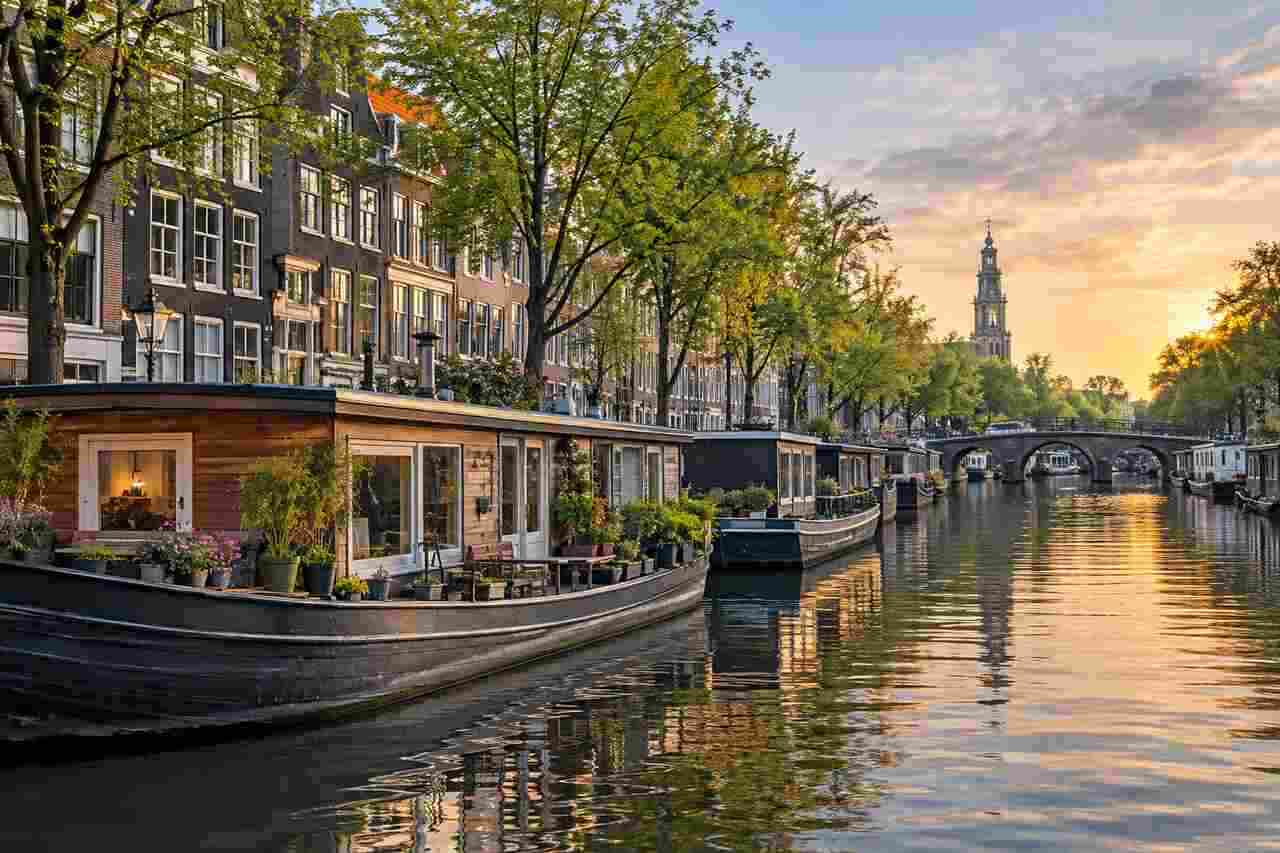
Amsterdam house boats are a distinctive part of the city’s canal culture, combining Amsterdam’s historic relationship with its waterways with modern residential living. Known in Dutch as woonboten, these floating homes range from converted historic cargo vessels to contemporary floating residences, with many serving as permanent homes while some are available as tourist accommodation.
What Are Amsterdam House Boats?
Amsterdam house boats, commonly called woonboten in Dutch, are boats or floating structures that have been converted or designed for residential use.
Unlike an ordinary boat used for cruising, a houseboat is generally intended to remain at a permanent mooring. It can have bedrooms, kitchens, bathrooms, heating, electricity, and other features you would expect in a conventional home.
Amsterdam’s houseboats come in many shapes and sizes. Some retain the appearance of traditional ships, while others look more like modern apartments floating on the water.
One of the best ways to understand the difference is to visit the Houseboat Museum on Prinsengracht. The museum is located aboard the Hendrika Maria, a former cargo ship built in 1914 that was later transformed into a residential houseboat.
Why Are Amsterdam House Boats So Popular?
Houseboats have become one of Amsterdam’s most recognizable symbols because they combine two things the city is famous for: historic waterways and compact urban living.
For visitors, staying on a houseboat can feel completely different from booking a conventional hotel. Instead of looking out at a canal from a room, you’re actually on the canal.
For residents, the attraction is more personal. A houseboat can provide a waterfront home in the middle of one of Europe’s most densely populated cities.
There is also an element of history. Amsterdam’s waterways played a major role in trade and transportation, and some residential boats began as working vessels. The Houseboat Museum explains how former cargo ships were converted into homes, particularly during periods when housing was difficult to find.
A Brief History of Houseboat Living in Amsterdam
Amsterdam’s canals were originally built for transportation, trade, drainage, and urban expansion. The historic canal belt remains one of the city’s defining features and is recognized as a UNESCO World Heritage site.
As Amsterdam developed, boats were a natural part of everyday life. Cargo vessels transported goods along the waterways, while families sometimes lived aboard ships.
During housing shortages, older vessels offered an alternative form of accommodation. Some were eventually converted into permanent homes.
Over time, houseboats changed from relatively basic accommodation into a distinctive form of Amsterdam housing. Today, you’ll find everything from traditional barges and historic vessels to contemporary floating homes.
The result is a fascinating mixture of maritime heritage and modern residential design.
What Types of House Boats Can You Find in Amsterdam?
There isn’t just one style of Amsterdam houseboat. The city’s floating homes can broadly be divided into several categories.
1. Converted Historic Ships
Some of the most visually interesting houseboats began life as cargo vessels.
Traditional Dutch vessels such as barges and tjalks can be converted into comfortable homes while retaining elements of their original maritime character.
The Houseboat Museum’s Hendrika Maria is a particularly good example. The 1914 cargo ship has been transformed into a living space while preserving its connection to Amsterdam’s shipping history.
2. Modern Floating Homes
Not every houseboat looks like a traditional ship.
Some modern floating homes have straight walls, large windows, contemporary kitchens, efficient heating systems, and spacious living areas. From the outside, they may resemble small modern houses sitting directly on the water.
These homes demonstrate how floating architecture has evolved beyond the traditional boat.
3. Concrete Floating Homes
Amsterdam also has houseboats constructed around floating concrete structures.
These can offer a more conventional floor plan than a converted ship, making them feel closer to an apartment or small detached house than a boat.
4. Tourist Houseboats
Some houseboats are available as visitor accommodation, allowing travelers to experience canal life temporarily.
However, tourists should not assume that every attractive houseboat they see can legally be rented for a holiday. Amsterdam has specific rules governing tourist rentals, including registration and permits.
Where Can You See Amsterdam House Boats?
Houseboats can be found throughout Amsterdam, particularly along canals and waterways in and around the central city.
Some of the most atmospheric areas include:
- Prinsengracht
- Jordaan
- Singel
- Amstel
- Various residential canals in Amsterdam-West and other neighborhoods
Prinsengracht is especially notable because it combines houseboats with historic canal architecture, cafés, shops, bridges, and major attractions.
Amsterdam’s official tourism organization also highlights houseboat-lined canals in Amsterdam-West, where visitors can combine waterfront scenery with neighborhoods and parks.
Prinsengracht
Prinsengracht is one of the best-known canals in Amsterdam’s historic canal belt.
It’s also home to the Houseboat Museum, making it an excellent place to learn about what these floating homes are actually like from the inside.
Jordaan
The Jordaan is one of Amsterdam’s most atmospheric neighborhoods, with narrow streets, cafés, galleries, historic buildings, and canals lined with houseboats.
Walking through the area gives you a good sense of how floating homes fit into ordinary city life.
Amsterdam-West
For travelers who want to get beyond the busiest central streets, Amsterdam-West provides opportunities to see houseboats in a more residential environment. I amsterdam specifically describes routes through the area as passing houseboat-lined canals.
What Is It Like Inside an Amsterdam House Boat?
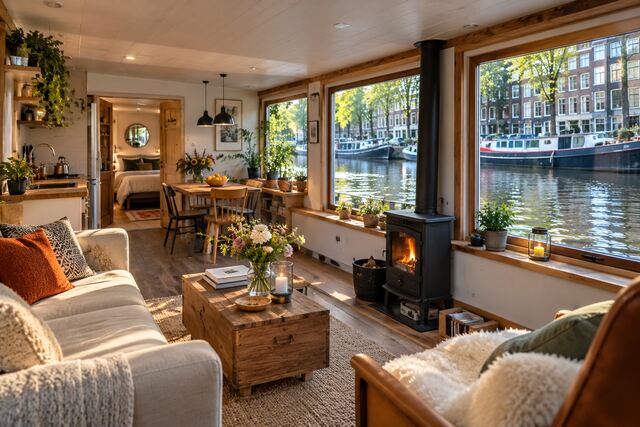
The interior of a houseboat may be much larger and more comfortable than you expect.
One common misconception is that living on a boat automatically means living in a tiny, cramped space. In reality, modern conversions can make remarkably efficient use of their available floor area.
The Houseboat Museum’s Hendrika Maria, for example, measures approximately 23 by 4.5 meters and has around 80 square meters of effective living space.
A typical residential houseboat may contain:
- A living room
- Kitchen
- One or more bedrooms
- Bathroom
- Storage areas
- Heating
- Electricity
- Water and wastewater systems
- Outdoor terrace or deck
Because floor space is limited, storage and interior design are particularly important.
Large windows are also common because they make the interior feel brighter while providing views directly onto the canal.
Is Living on an Amsterdam House Boat Comfortable?
For the right person, absolutely.
Modern houseboats can provide many of the comforts of a conventional home. However, living on the water also introduces responsibilities that you wouldn’t encounter in an ordinary apartment.
For example, owners need to consider:
- Maintenance of the vessel or floating structure
- Plumbing and wastewater systems
- Heating and insulation
- Moisture management
- Mooring regulations
- Insurance
- Access and utilities
- Long-term structural maintenance
The Houseboat Museum emphasizes that living on a boat has its own practical realities and gives visitors an opportunity to experience those differences firsthand.
So while an Amsterdam houseboat can be charming, it shouldn’t be viewed simply as an apartment with water underneath it.
Can You Stay on an Amsterdam House Boat?
Yes, some houseboats are offered as tourist accommodation, but availability and legality depend on the individual property and current regulations.
Amsterdam requires a registration number and holiday-rental permit for renting out a home or houseboat to tourists. Owners must also report each rental period before guests arrive.
The city normally limits holiday rentals to 30 nights per calendar year, with stricter limits in parts of Centrum and De Pijp. A maximum of four guests can normally stay at one time under the holiday-rental rules.
That means travelers should always book through legitimate accommodation providers and check the property’s current rental status rather than assuming that any houseboat advertised online is permitted for short-term stays.
How Much Does an Amsterdam House Boat Cost?
There isn’t one standard price for an Amsterdam houseboat.
The value of a houseboat depends on factors such as:
- Location
- Size
- Age
- Condition
- Type of vessel
- Interior quality
- Mooring situation
- Legal status
- Waterfront location
- Renovation requirements
Houseboats in desirable central areas can be expensive. The Houseboat Museum notes that houseboat living has evolved considerably from its earlier reputation as an inexpensive housing solution and can now represent a substantial property investment.
For someone considering buying one, the cost of the structure itself is therefore only part of the financial equation.
Do Amsterdam House Boats Have Permanent Mooring Rights?
This is one of the most important things to understand.
A houseboat isn’t simply free to move to any canal and stay there permanently.
Amsterdam has a system of mooring permits for residential houseboats. The city’s housing information specifically provides procedures for applying for a residential houseboat mooring permit and for altering or replacing a houseboat.
The city’s boating guidance also distinguishes ordinary temporary docking from houseboats with permanent mooring permits.
Therefore, anyone thinking about buying a houseboat should investigate the associated mooring rights and municipal requirements before purchasing.
Can You Buy an Amsterdam House Boat?
Yes, houseboats can be bought, but purchasing one is more complicated than buying an ordinary apartment.
A prospective buyer should investigate:
- The vessel or floating structure
- The permanent mooring rights
- Municipal permits
- Property valuation
- Insurance
- Maintenance history
- Utilities and connections
- Renovation restrictions
- Applicable taxes and fees
- Any restrictions on renting the property
This is particularly important because the houseboat and its location on the water are closely connected.
Amsterdam’s rules also apply specifically to houseboats in areas such as rental regulation and property valuation. For example, the city states that houseboats use an RRB value for certain buyout-protection calculations.
If you’re considering an actual purchase, professional Dutch legal, property, and municipal advice is essential.
What Are the Advantages of Living on a House Boat?
Houseboat living offers several unique benefits.
Waterfront Views
Perhaps the biggest attraction is obvious: your home is directly on the water.
Instead of looking down onto a canal from a traditional apartment, you experience the canal from water level.
A Unique Lifestyle
Few residential experiences are as closely associated with Amsterdam as waking up aboard a floating home.
Central Location
Some houseboats are located close to Amsterdam’s historic center, restaurants, museums, shopping areas, and public transportation.
Character
Older converted vessels can have a personality that is difficult to reproduce in a conventional apartment.
Connection With Amsterdam’s Canals
Living on the water makes the city’s maritime history part of everyday life rather than simply something to observe on a canal cruise.
What Are the Disadvantages?
Houseboat living isn’t for everyone.
Maintenance
A floating home requires specialized maintenance, and older vessels can require significant care.
Limited Space
Even well-designed houseboats can have less storage and living space than comparable conventional homes.
Moisture
Living directly over water means moisture and ventilation deserve particular attention.
Access
Depending on the location, getting on and off the boat can be less convenient than entering a standard apartment building.
Regulations
Mooring, renovation, rental, and other municipal rules can be complicated.
Cost
A houseboat shouldn’t automatically be considered a cheap alternative to traditional Amsterdam housing.
Amsterdam House Boats vs. Canal Houses
The two offer completely different experiences.
| Feature | Amsterdam House Boats | Traditional Canal Houses |
|---|---|---|
| Location | On the water | Beside the canal |
| Character | Maritime / floating | Historic architectural |
| Outdoor experience | Direct waterfront | Canal-side |
| Maintenance | Vessel and floating systems | Building and foundations |
| Space | Often highly optimized | Can be narrow and vertically arranged |
| Lifestyle | Water-oriented | Traditional urban living |
| Tourist appeal | Very distinctive | Iconic Amsterdam architecture |
If your priority is historical architecture, a canal house may appeal more. If you want something unconventional and closely connected to the water, a houseboat offers a completely different experience.
The Best Way to Experience Amsterdam House Boats as a Tourist
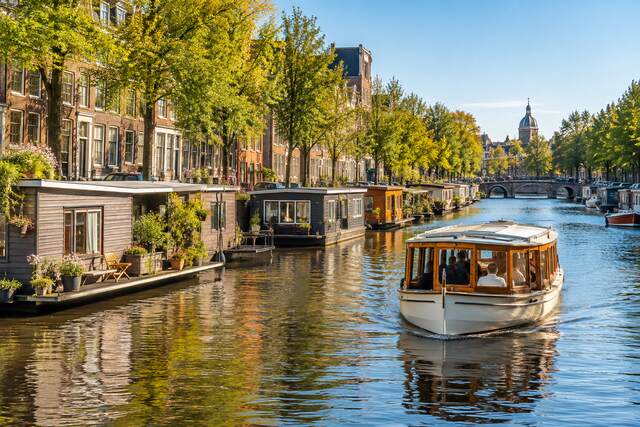
You don’t necessarily need to rent one to experience the houseboat lifestyle.
A particularly useful option is the Houseboat Museum on Prinsengracht.
The museum occupies the historic Hendrika Maria and allows visitors to see the interior of a real converted cargo vessel. It also explains how people lived aboard such vessels and how the boat was transformed into a residential space.
This is especially useful if you’ve ever wondered:
- How do houseboats get electricity?
- Where does wastewater go?
- Are houseboats cold in winter?
- How much space is inside?
- How are old ships converted into homes?
- What is everyday life on the canal actually like?
The museum is located at Prinsengracht 296K in Amsterdam.
Tips for Photographing Amsterdam House Boats
Houseboats are easy to photograph while walking around Amsterdam, but remember that they are people’s homes.
A few simple etiquette rules make the experience better:
- Don’t enter private moorings without permission.
- Avoid photographing people through windows.
- Don’t block narrow walkways while taking pictures.
- Keep noise down around residential boats.
- Don’t climb onto boats or private decks.
- Remember that a picturesque houseboat is still someone’s home.
The best photographs often come from public streets and bridges where the boat is naturally framed against Amsterdam’s historic canal architecture.
Are Amsterdam House Boats Environmentally Friendly?
The answer depends on the individual houseboat.
Some modern floating homes can incorporate energy-efficient heating, insulation, solar panels, and other sustainable technologies. Older vessels may require more energy or substantial upgrades.
Amsterdam’s wider approach to its waterways also increasingly emphasizes cleaner boating. For example, the city’s boating guidance includes restrictions on certain older two-stroke outboard motors and encourages boaters to help keep the canals clean.
The sustainability of a particular houseboat therefore depends heavily on its construction, age, systems, and renovations.
Final Thoughts on Amsterdam House Boats
Amsterdam house boats offer a fascinating look at a side of the city that you cannot fully appreciate from a traditional canal cruise.
They combine Amsterdam’s centuries-old relationship with water with modern ideas about housing, architecture, and urban living. Some are historic vessels that have been carefully converted into homes; others are contemporary floating residences designed specifically for life on the canals.
For travelers, a houseboat stay can provide an unforgettable Amsterdam experience. For architecture and history enthusiasts, simply walking along the houseboat-lined canals reveals how closely the city’s identity is connected to its waterways.
And if you want to understand what life inside one is really like, visiting the Houseboat Museum is one of the most direct ways to step beyond the postcard image and experience the practical reality of living on the water.
Explore lifestylewifey.com for practical ideas and inspiration across family, home decor, business, lifestyle, and travel.
FAQ’s
Yes. Many Amsterdam houseboats are permanent residences rather than tourist attractions. They can contain kitchens, bathrooms, bedrooms, living rooms, utilities, and other features of a conventional home.
Yes, some houseboats are available as tourist accommodation. However, Amsterdam regulates holiday rentals, and properties need to comply with the city’s registration and permit requirements.
The Houseboat Museum is located on Prinsengracht 296K in Amsterdam’s Jordaan area. It occupies the historic Hendrika Maria cargo ship.
Some can be. Prices vary significantly according to location, size, condition, vessel type, and mooring arrangements. Houseboat ownership is no longer necessarily a low-cost form of housing.
Yes, but buyers need to consider both the houseboat and its legal mooring situation. Municipal permits and other regulations can be important parts of the purchase.
Some vessels are capable of moving, but residential houseboats with permanent moorings generally function as stationary homes. Moving a residential houseboat can involve significant practical and regulatory considerations.
A residential houseboat is commonly referred to as a woonboot in Dutch.
The Houseboat Museum is one of the best-known attractions dedicated specifically to houseboat living. It lets visitors explore the inside of a historic converted cargo vessel.
